
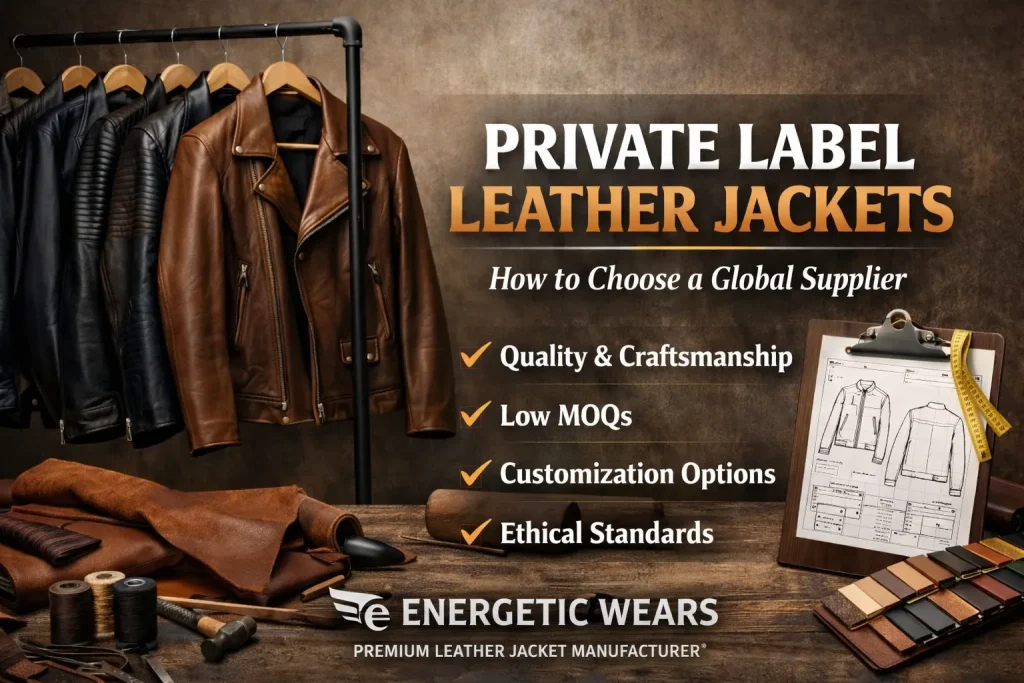
The global market for leather outerwear has expanded rapidly over the past decade, fueled by direct to consumer (DTC) brands, boutique labels, designer collections, and private label manufacturers that support those brands behind the scenes. For new and established fashion businesses alike, private label leather jackets offer an opportunity to differentiate product assortments, strengthen brand identity, and deliver premium value without needing to build a factory footprint.
Yet, sourcing leather jackets at the private label level is not a simple procurement exercise. Leather is a complex material category, with significant variations in hides, tanning, grading, construction, hardware, and finishing. Manufacturers differ widely in capabilities, quality standards, MOQs, customization options, and service models. To make profitable sourcing decisions and avoid costly missteps buyers need a structured understanding of what separates an ordinary factory from a strategic OEM partner.
This guide breaks down the critical factors buyers should evaluate when sourcing private label leather jackets globally, using industry benchmarks from experienced manufacturers such as Energetic Wears, a leading producer of custom wholesale leather jackets and leather garments for boutique brands and retailers.
Assess Material Expertise and Leather Specialization
Leather sourcing is foundational. The type of leather, tanning method, thickness, hand feel, and finish determines not only the tactile experience and durability, but also price positioning and brand value.
Key criteria include:
- Leather Variety: Goat, sheep, lamb, cowhide, and buffalo each serve different consumer segments and market tiers.
- Tanning Methods: Chrome tanned vs. vegetable tanned vs. hybrid tanning impacts color vibrancy, aging, sustainability narratives, and lead times.
- Finishing: Waxed, aniline, semi aniline, nubuck, suede, distressed, and oil pull up finishes require technical control to execute correctly.
- Traceability: US, UK, and EU buyers increasingly request transparent supply chains.
Manufacturers such as Energetic Wears invest in leather sourcing networks and in house inspection processes to ensure hides match the specification profile of the buyer’s brand segment luxury, premium, lifestyle, or mass market.
Evaluate Pattern Development and Customization Capabilities
Private label buyers often underestimate the complexity of pattern making for leather. Unlike textiles, leather does not stretch or drape uniformly, requiring precision during pattern development and panel preparation.
Ask the manufacturer:
- Do they offer in house pattern creation or grading services?
- Can they interpret sketches, tech packs, or reference garments?
- How deeply can they customize silhouettes, hardware, branding elements, cuffs, collars, linings, and pocketing?
- Can they differentiate between men’s, women’s, and unisex fit standards?
Energetic Wears provides OEM customization for emerging brands and boutiques that require differentiation in design without investing in full design studio overhead.
Understand Construction Standards and Technical Workmanship
Quality leather construction is defined by consistency. Elements such as stitch density, seam stability, panel matching, zipper alignment, and lining installation influence retail survivability and brand perception.
Examine:
- Stitching type (single needle, double needle, top stitch, edge finish)
- SPI (stitch per inch) uniformity
- Hardware brands (YKK, RiRi, etc.)
- Pocket construction
- Lining and interlining materials
- Collar and cuff reinforcement
- Panel symmetry
Factories specializing in private label production for international markets such as Energetic Wears calibrate their quality assurance protocols against US, UK, and EU retail expectations.
Clarify MOQ, Pricing Strategy, and Commercial Terms
Minimum order quantities (MOQs) are a decisive factor for new brands. Boutique labels typically lack the volume of corporate retailers and need flexible scale up options.
A global manufacturer should provide:
- Tiered MOQs (per style, per color)
- Transparent wholesale pricing based on hides, finish, and complexity
- Sample cost structure and reimbursement policies
- Production lead times by season
- Freight, customs, and logistics guidance
Energetic Wears accommodates lower MOQs for startup brands and boutique stores who are testing leather for the first time while maintaining premium standards.
Review Sampling, Prototyping, and Pre Production Processes
A robust sampling phase is essential for private label sourcing. It enables designers and buyers to validate fit, construction, finish, and aesthetic differentiation before scaling.
Look for:
- Sample turnaround timelines
- Pattern iteration flexibility
- Fit corrections and revision protocols
- Pre production approval systems (PPs)
- Swatch and finish verification
Manufacturers serving serious private label buyers support multi round sampling for investment level products such as leather jackets, rather than forcing final approvals off first pass units.
Test Communication, Responsiveness, and Technical Literacy
Private label sourcing is collaborative. Be wary of factories that operate with transactional communication. Buyers benefit from manufacturers that understand branding, consumer positioning, seasonal merchandising, and trend adaptation.
Strong global OEM partners:
- Respond quickly and clearly
- Interpret product briefs and technical packs
- Support brand positioning
- Suggest construction optimizations
- Understand international sizing and retail standards
Energetic Wears’ development teams routinely collaborate with boutique owners, fashion startups, and wholesale brands who rely on high communication fidelity to reduce production risks.
Review Ethical, Compliance, and Sustainability Criteria
Fashion buyers increasingly face scrutiny regarding sourcing ethics, animal products, sustainability, labor practices, and environmental compliance. Private label leather is no exception.
Buyers should request:
- Material traceability where applicable
- Compliance documentation
- Labor practice transparency
- Environmental and waste management information
- Relevant certifications (if required for market entry)
Failure to consider compliance upstream can create market friction later, especially for EU, UK, and premium US retail channels.
Confirm After Sales Support and Long Term Partnership Potential
Private label suppliers are not just factories they are development partners. Long term value emerges from stability, consistency, and incremental quality improvement.
Indicators of viable partnership include:
- Ability to scale volume
- Seasonal reordering
- Design evolution support
- Warranty or defect management policies
- Expansion into accessories or adjacent categories
Energetic Wears supports multi season programs for brands seeking continuity in leather outerwear, as well as expansion into leather gloves and related categories.
Conclusion: Choose Strategic Partners, Not Just Factories
Private label leather jacket sourcing requires technical discernment, commercial analysis, and brand alignment. Factories that combine material expertise, pattern development, customization, flexible MOQs, international QA standards, and responsive communication such as Energetic Wears provide a strategic advantage to brands entering or scaling in the leather category.
For boutique labels, fashion startups, and retailers aiming to differentiate through leather, selecting the right global manufacturing partner is one of the most consequential product decisions they will make.